Best Walking Pad for Seniors: 5 Safe, Low-Speed Models (2026)
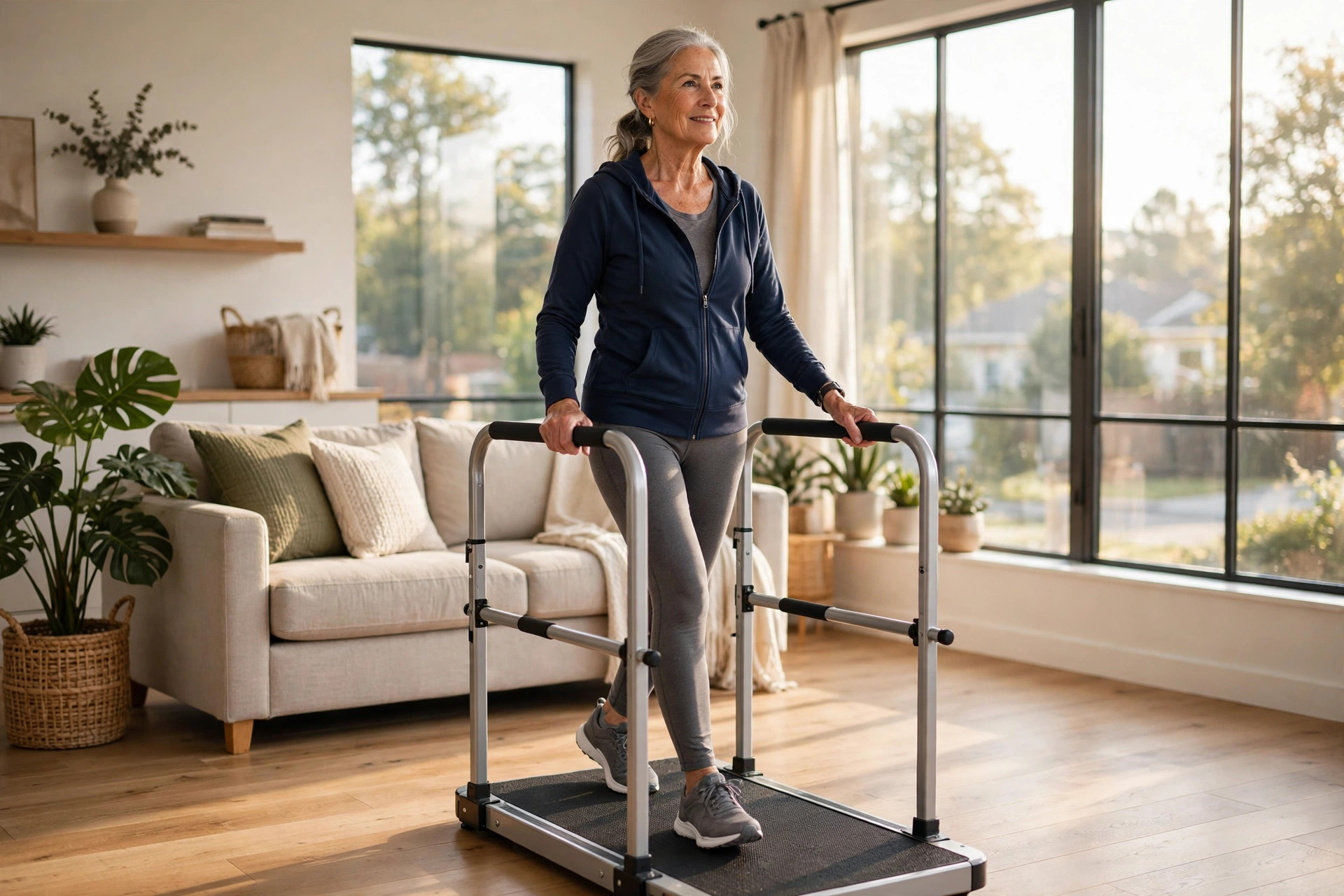
Most walking pad roundups are written for desk workers in their thirties. Seniors have different non-negotiables: something to hold onto, a belt that starts slow enough to step onto without a lurch, and a stop that works when it matters. A flat, rail-free pad may suit a 30-year-old; for an older walker, it is a risk.
The five models below were chosen for senior-relevant safety first: handrails, low minimum speeds, emergency stops, wide belts, and honest capacities. Every price and spec was checked against manufacturer pages and independent reviews in October 2026. Where a figure could not be verified, we say so instead of printing it.
Quick picks
- Best senior fit: Exerpeutic TF1000 — purpose-built walking treadmill (4 mph cap), 20″ wide belt, 400-lb capacity, 18″ handles. ~$669.
- Best stability for the money: UREVO FoldiMix 5L — height-adjustable handrail, safety key, 400-lb capacity at $349.99 (MSRP $499.99).
- Best documented safety: KingSmith WalkingPad R1 Pro — emergency-stop clip, child lock, novice speed limit, slowest start here (0.31 mph). $599.
- Simplest to start: Egofit Walker Plus M1T — walking-only (3.73 mph cap), fold-flat rails. $459 on Amazon, $329 on sale direct.
- Best budget: Goplus SF-T7945 2-in-1 — handrail plus safety key at $149.99. Watch the 265-lb capacity and narrower belt.
Comparison table
| Model | Capacity | Speed range | Belt size | Safety features | Price |
|---|---|---|---|---|---|
| Exerpeutic TF1000 | 400 lbs | 0–4 mph (0.1 mph steps) | 40″ × 20″ | 18″ handles, wide side rails, handlebar buttons | ~$669 |
| UREVO FoldiMix 5L | 400 lbs | 0.6–7.6 mph | 39.4″ × 15.8″ | Adjustable handrail, safety key | $349.99 |
| KingSmith WalkingPad R1 Pro | 242.5 lbs | 0.31–6.2 mph | 47.2″ × 17.3″ | Emergency clip, child lock, novice limit, retractable rail | $599 |
| Egofit Walker Plus M1T | 220 lbs | 0.62–3.73 mph | 34.25″ × 16.54″ | Fold-flat handrails (no safety key listed) | $329–$459 |
| Goplus SF-T7945 | 265 lbs | 0.6–2.5 mph (walk mode) | 40″ × 16″ | Handrail, safety key | $149.99 |
Figures come from manufacturer pages and independent reviews checked October 2026. Where sources conflicted, we used the manufacturer’s official figure. Horsepower figures marked “max” or “peak” are not continuous-duty ratings.
What makes a walking pad senior-safe
1. Handrails beat remote-only designs
The defining feature of a senior-suitable pad is something to hold. A flat, handle-free pad saves space, but it removes the recovery option when balance wobbles. Rails must be reachable without leaning — the UREVO’s adjustable handrail and the Exerpeutic’s long fixed handles both qualify. If the rail is a stretch to reach, it is decoration, not safety.
2. A low, gradual start matters more than top speed
Senior walkers need to step onto a belt that is barely moving and ramp up slowly. A 0.6 mph start is a gentle stroll; a 1.0 mph start on some pads is a brisk shove. The KingSmith R1 Pro’s 0.31 mph minimum is the slowest in this roundup — roughly half the speed of a casual walk.
3. Emergency stop should be physical, not a touchscreen
For older users, the standard is a mechanism that stops the belt instantly without looking down: a pull-cord safety key that clips to clothing (Goplus, UREVO), or a handlebar stop button (Exerpeutic). The KingSmith goes further with an emergency-stop clip plus a child lock and a novice speed limit for first sessions. A stop that requires tapping an app is not a stop.
4. Belt width buys forgiveness
Aging gait tends to widen and wander. A 20-inch belt (Exerpeutic) gives lateral room that a 15-inch belt does not. The category standard is around 15–16 inches wide; anything below that deserves a narrower-stance user.
5. Capacity ratings deserve the same skepticism here
A 220-lb rating (Egofit) or 242.5-lb rating (KingSmith) is a ceiling, not a suggestion: a pad run near its limit runs louder and wears faster. If you are within 15% of the rating, choose the next tier up. See our heavy-capacity guide for the full explanation.
6. Low deck height and a readable display
A high step-on deck is a trip risk before the walk even starts — the LifeSpan TR1200i’s 8.25-inch step-up is one reason it did not make this list. A large, readable display matters too: you should not have to squint down at your feet to read your speed.
Full reviews
Exerpeutic TF1000 “Walk to Fitness”
The 20-inch belt is the widest here by a clear margin, and the 400-lb capacity is backed by the 120-lb frame — the heaviest in this roundup.
The handlebar layout is built for older users: extra-long 18-inch handles, speed and on/off buttons on the handrail so you never reach across the belt, and wide side rails for stepping off. The LCD shows time, distance, calories, speed, and pulse. Two honest caveats: the exact minimum start speed was not verifiable in official specs (only the 0–4 mph range in 0.1 mph steps), and a safety key is reported by third-party retailers but does not appear in official copy.
- Widest belt here (20″) — real lateral room
- 400-lb capacity on a 120-lb frame
- Handlebar controls; no reaching across the belt
- 0.1 mph increments for fine control
- Minimum start speed not verifiable in official specs
- Safety key reported by retailers, absent from official copy
- 120 lbs — not portable; plan a permanent spot
- ~$669 price is third-party; verify live price
The closest thing to a purpose-built senior walker. The belt width, rail layout, and frame weight are all best-in-class for this audience.
Prices change frequently — the button checks the live price.
UREVO FoldiMix 5L Smart Treadmill
The FoldiMix 5L delivers the two headline numbers seniors care about — 400-lb capacity and a real handrail — at a price nothing else here touches. The height-adjustable handrail matters (wrong-height rails are a hazard, not a help), a safety key is included, and the belt has 14-point shock absorption.
The trade-offs are speed range and published data. The motor is rated 3.0 HP maximum with no continuous-duty figure published, so treat the number with the usual skepticism. And 0.6 mph is a fine start, but this pad’s top end reaches 7.6 mph — a jogging machine wearing a walker’s price tag. For senior use, the top half of that range should simply never be used. The $349.99 checkout price at urevo.com (against a $499.99 MSRP) is verified as of October 2026.
- 400-lb capacity at $349.99 — best stability-per-dollar here
- Height-adjustable handrail
- Safety key included
- 14-point shock absorption
- Motor HP is “max”, not continuous — rating unverified
- 7.6 mph top speed invites misuse; senior users should cap it
- 15.8″ belt is narrower than the Exerpeutic
The value pick for heavier seniors. Set the speed cap, use the handrail, and ignore the running modes.
Prices change frequently — the button checks the live price.
KingSmith WalkingPad R1 Pro
No other pad here documents its safety features like the R1 Pro: an emergency-stop safety clip, a child lock, a novice speed limit for first sessions, auto-standby, and overload protection. The 0.31 mph minimum start is the slowest in this roundup — useful for cautious first sessions. The belt is also the longest and widest of the folding models at 47.2 × 17.3 inches.
Be careful with third-party numbers: Amazon US listings show different figures (0.5 mph minimum, 240-lb capacity, 25 kg weight). We used KingSmith’s official metric-derived figures above. The 242.5-lb capacity is one of the lower ratings here — if you are near it, the Exerpeutic or UREVO is the safer choice. At 72.8 lbs it is one of the heavier folding models (the Goplus is 74 lbs), so plan for it to live in one place.
- Emergency clip + child lock + novice speed limit
- Slowest start here (0.31 mph)
- Longest belt of the folding models (47.2″)
- Published continuous HP — rare in this category
- 242.5-lb capacity is on the lower end here
- Marketplace listings show conflicting specs — verify against official site
- 72.8 lbs; heavy to fold and move
The safest documented design. Best for lighter seniors who want the most engineered safety net available.
Prices change frequently — the button checks the live price.
Egofit Walker Plus M1T
The M1T’s appeal is simplicity: it is a walking-only machine with a 3.73 mph ceiling, so there is no running mode to accidentally discover. The fold-flat handrails mean the unit still stores under a couch or against a wall. The 3.94-inch LCD is large enough to read without squinting, and control comes via remote and app.
Two limitations need stating plainly. First, the 220-lb capacity is the lowest in this guide — anyone above ~190 lbs should pick a higher-rated model. Second, no safety key is listed in the specs: the stop mechanism is the remote and app, which is weaker protection than a physical pull-cord.
- Walking-only design — no running mode to worry about
- Fold-flat handrails; stores easily
- Large 3.94″ readable display
- $329 sale price at egofitwalker.com is strong value
- 220-lb capacity — lowest here
- No safety key listed; remote/app stop only
- 34.25″ belt is short for taller users
The simplest machine here. Right for lighter, steady-on-their-feet beginners; wrong for anyone who needs a physical stop.
Prices change frequently — the button checks the live price.
Goplus SF-T7945 (Superfit 2-in-1)
At $149.99 on goplusus.com, the SF-T7945 is the cheapest way to get the two senior essentials: a handrail and a safety key. The walk mode caps at 2.5 mph, which is a sensible ceiling for older users — the 7.5 mph running mode with the rail raised is irrelevant for this audience and should stay untouched. The 40-inch belt is decently long.
The compromises are real: a 265-lb capacity, a 16-inch belt on the narrower side, slimmer rails, and a 2.25 HP peak motor with no continuous rating. This is the budget entry point — acceptable for a lighter senior who will use it gently, not the pick for someone who needs maximum stability.
- $149.99 — cheapest handrail + safety key combo here
- Walk mode capped at a sensible 2.5 mph
- 40″ belt length is good for the price
- Folds flat — our 2026 roundup lists this 2-in-1’s folded profile at 5″
- 265-lb capacity; not for heavier users
- 16″ belt is narrower than average
- Slimmer rails suit a light steadying touch, not full body-weight leaning
- Motor HP is peak-rated; continuous duty unlisted
The budget on-ramp. Fine for lighter seniors at gentle speeds; everyone else should spend up for rails and capacity.
Prices change frequently — the button checks the live price.
Frequently asked questions
Is a walking pad safe for seniors?
A walking pad with handrails, a low starting speed, and an emergency-stop key is as safe as any home cardio option when used sensibly. The risk profile changes sharply without rails: balance wobbles that a younger user recovers from can become falls for older users. Anyone with a balance disorder, a history of falls, or a heart condition should check with their doctor first, and keep someone nearby for the first sessions.
What speed should a senior start at?
Start at the pad’s lowest setting — typically 0.3–0.6 mph on the models here — and stay there for the first week. A comfortable walking pace for most older adults lands between 1.5 and 2.5 mph. There is no prize for speed; consistency beats intensity at every age.
Do I really need handrails, or is a flat pad fine?
For seniors, get the rails. A flat, rail-free pad is designed for under-desk use by people who grab furniture when they stumble — that assumption fails for older users. Holding a rail lightly also steadies gait, reducing the small wobbles that precede falls.
What is the Sperax warning about?
In April 2026 the CPSC issued Warning #26-415 against Sperax walking pads and treadmills (Pro, Q1, RM-01, RM-02): stop using them immediately and dispose of them. The warning cites 201 reports of speed and stability problems causing 66+ falls and injuries (including one concussion), and 573 overheating reports causing 4 minor burns. The importer refused a recall, so there is no refund or repair program. If you own one, stop using it.
Walking pad or full treadmill for a senior?
A walking pad with rails wins on price, weight, noise, and storage — and for walking-only use it is enough. A full treadmill wins on rail height, deck length, and motor durability for heavier or taller users, and ETL-certified models (like the LifeSpan TR1200i) add an independent safety certification. If the user is over 250 lbs, needs to lean on rails, or wants to walk daily for years, the treadmill is the better long-term tool.
Prices move. We check regularly but the checkout number may differ. See our affiliate disclosure for how we fund the research.